
Four Takeaways From the Texans’ Wild-Card Win Over the Steelers
Houston’s defense looked like the NFL’s No. 1 unit
In a postseason setting where one dominant unit can tilt an entire game, the Houston Texans made a loud case that their defense is not only statistically elite, but also built to travel and win in January. On Monday night at Acrisure Stadium in Pittsburgh, the Texans stifled the Steelers in a 30-6 AFC wild-card victory, holding Pittsburgh to just 176 total yards and controlling the rhythm of the game from the opening stages through the final minutes.
It is easy to downplay a defensive performance when it comes against an offense that struggles, but the Texans’ showing was notable because it was comprehensive. Houston’s coverage remained tight throughout the night, and the Steelers’ most dangerous receiving threat, DK Metcalf, never found the kind of space that can flip a playoff game. The Texans also paired that coverage with a pass rush that appeared to get stronger as the game progressed, particularly after halftime, when the pressure became more consistent and more damaging.
The defining defensive moment came with 11:23 remaining, when pass rusher Will Anderson recorded a sack that forced a fumble from Aaron Rodgers. Defensive tackle Sheldon Rankins scooped it up and returned it 33 yards for a touchdown, turning a controlled game into a decisive one and pushing Houston ahead 17-3. The Texans added a second defensive touchdown later, when safety Calen Bullock returned an interception 50 yards for a score, underscoring how Houston’s defense did not merely contain the Steelers—it directly produced points.
The run defense was equally discouraging for Pittsburgh. Running lanes were scarce, and the Steelers ended up running on only about one quarter of their offensive plays. Whether that was a strategic choice or a reflection of what the Texans were taking away, the result was the same: Houston dictated what Pittsburgh could and could not attempt.
Houston’s path will become more demanding now that a weaker offense is out of the bracket, but the Texans’ body of work—combined with what they showed in this game—offers little reason to assume they will be overwhelmed by a higher-caliber opponent. The defense looked fast, disciplined, and opportunistic, which is exactly the profile teams hope to carry into the Divisional Round.
A run-first approach helped Houston control the game
One of the most striking elements of the Texans’ offensive plan was how often their most productive stretches came when they leaned on the run. That is not necessarily how the Texans were defined during the regular season, when they averaged 108.9 rushing yards per game, ranking 22nd in the league. Yet in this matchup, a commitment to the ground game helped Houston move the ball, manage the clock, and keep its defense in favorable situations.
Rookie running back Woody Marks delivered his best rushing output of the season, gaining 112 yards on 19 carries. Beyond the raw total, it was the way Houston used him that stood out. The Texans relied on Marks more like a workhorse than they had for much of the season, and the results were especially evident on their best drive of the first half: a 14-play, 92-yard march that consumed 7:01 and ended in a touchdown.
That drive offered a clear snapshot of Houston’s most effective formula on the night. The Texans ran the ball seven times for 55 yards during that possession, mixing in enough variety to keep the Steelers from teeing off on obvious passing situations. The cumulative effect was that Houston stayed on schedule, reduced negative plays, and forced Pittsburgh to defend longer stretches without the quick relief that comes from a punt or a turnover.
The bigger takeaway is what this might mean for Houston going forward. The Texans are powered by a top-ranked defense, and pairing that with a reliable rushing attack can be a playoff-friendly equation. It is not a statement that Houston must abandon the pass, but rather that the Texans looked most stable when they could take pressure off their quarterback, shorten the game, and let their defense set the tone.
If Houston can continue to back its defense with a productive ground game, it may have a repeatable approach that travels well from one postseason week to the next. Monday’s win suggested that when the Texans are able to run effectively, they become harder to disrupt and more capable of protecting leads.
C.J. Stroud’s night was productive, but uneven
The Texans advanced, and C.J. Stroud finished with generally solid passing numbers: 21-of-32 for 250 yards with one touchdown and one interception. On paper, that is a line that can win a playoff game, especially when paired with a defense that scores twice. But the performance also included stretches that raised questions about consistency and control.
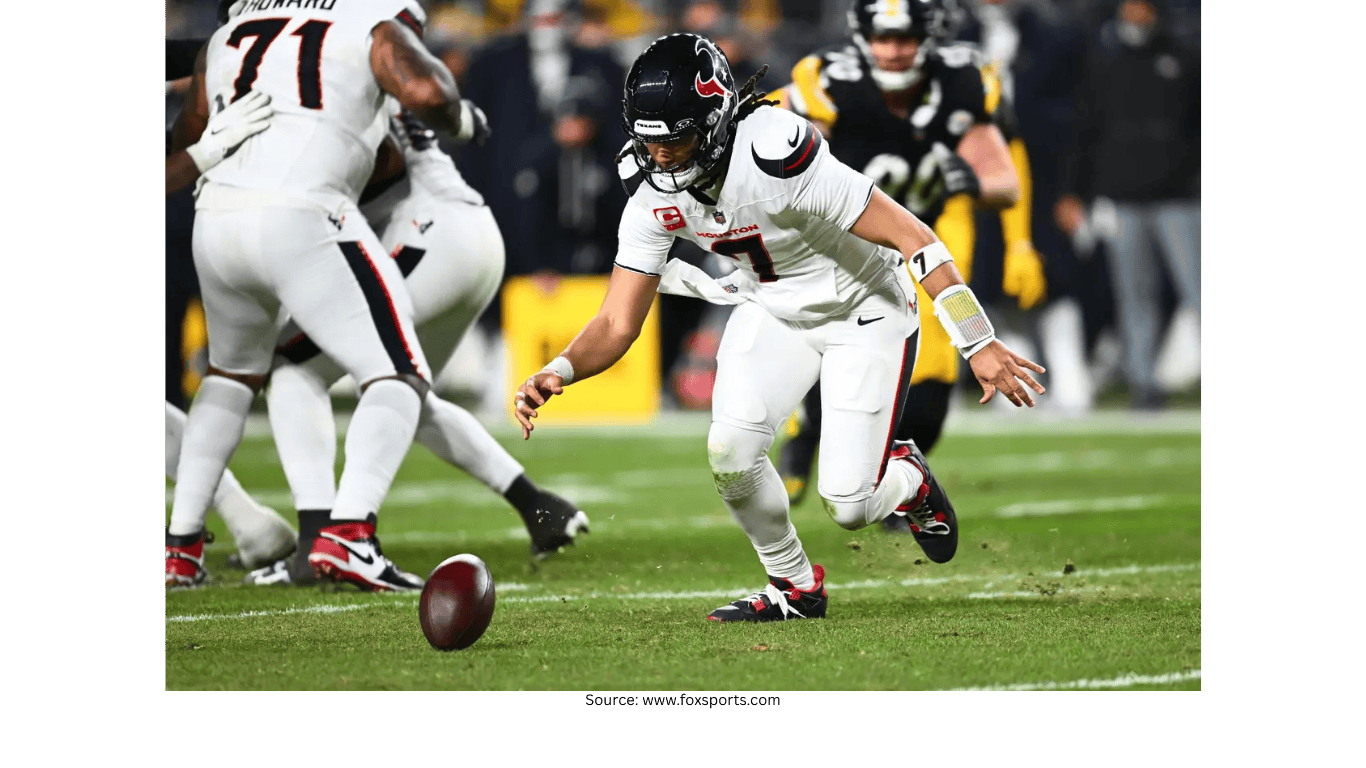
Stroud was rattled at times by the Steelers’ pass rush. He fumbled three shotgun snaps, and while not every mistake proved costly, the sequence of miscues created moments where Houston could have let the game swing back toward Pittsburgh. Stroud also appeared hurried on some throws, and there were times when he seemed stuck in the pocket, unable to escape. The Texans ultimately overcame those issues, but they were visible enough to stand out in a postseason environment.
Two lost fumbles and a costly interception near the Steelers’ 4-yard line were the kind of mistakes that can change a playoff game against a stronger opponent. Houston’s defense was good enough to erase them on this night, which is a reminder of how high the Texans’ defensive floor can be. Still, it also illustrated a reality Houston may need to manage as it moves deeper into the postseason: the margin for error can shrink quickly.
There is also a broader context to Stroud’s season. He was once viewed as a quarterback with the potential to become the next great star at the position, and two years ago he threw for 4,108 yards with 23 touchdown passes and only five interceptions, looking like a budding superstar. In his third year, he has looked good, but not dominant, and his regular-season production was described as decent but not overwhelming.
The key point from this game is not that Houston cannot win with Stroud playing like he did on Monday. In fact, the Texans demonstrated they can. The more important takeaway is that the best version of Houston may be one where Stroud does not have to carry the offense every week. With a defense capable of controlling games, Houston can afford to focus on efficiency, ball security, and complementary football—especially if the run game continues to contribute.
Pittsburgh faces major questions after a difficult finish
For the Steelers, the wild-card loss was not just the end of a season; it may also be the beginning of an offseason filled with uncertainty. Aaron Rodgers, 43, entered the night hoping for a storybook ending to a legendary career, but the Texans’ defense offered no such script. Rodgers finished 17-of-33 for 146 yards with no touchdowns and one interception, and the Steelers’ offense never found a way to consistently threaten Houston downfield or on the ground.
Even acknowledging Houston’s status as the NFL’s No. 1 defense, Pittsburgh’s limitations were clear. Outside of DK Metcalf, the Steelers did not appear to have elite playmakers who could consistently win against tight coverage, and Rodgers—given his physical limitations—needed more help than he received. The Steelers also did not provide a strong running game, and the offense leaned heavily on Rodgers to create solutions with experience and timing rather than mobility.
Rodgers did help the Steelers reach significant milestones, including getting them to the playoffs and to the AFC North title. But in this matchup, his lack of mobility and inconsistent arm strength were difficult obstacles, particularly when the supporting cast could not consistently separate or generate easy yards. If this was the end of his career, it was not the ending he would have chosen, though one moment from the season was presented as a more fitting memory: a come-from-behind win over the Ravens in the regular-season finale.
Now Pittsburgh must consider what comes next. There is uncertainty about whether Rodgers will want to play a 22nd NFL season, and whether the Steelers would want him back if he does. There is also speculation surrounding head coach Mike Tomlin’s future. While he is not described as being in danger of being fired after 19 seasons, there has been discussion about whether he might choose to step away or whether he and management could decide to mutually part ways.
That combination of variables makes the Steelers’ offseason unusually open-ended. A rebuild behind a new coach and quarterback is possible, but so is a return of both Tomlin and Rodgers for another attempt. What Monday’s game made clear is that Pittsburgh’s current approach struggled to generate answers against top-tier defenses, and the organization’s next decisions will shape whether it tries to adjust around its veteran quarterback or turns the page entirely.
What’s next: Houston heads to New England
With the win, the fifth-seeded Texans (13-5) extended their surge, carrying a 10-game winning streak into the Divisional Round. Their season included a difficult stretch earlier, as they were 3-5 after their first game in November, making the current run even more notable. Next, Houston will travel to New England on Sunday to face the No. 2-seed Patriots (15-3).
The Patriots enter that matchup after a 16-3 Wild Card Round win over the Los Angeles Chargers. In that game, quarterback Drake Maye threw for 268 yards and a touchdown, but New England’s defense was the centerpiece, allowing just 207 yards. The matchup therefore sets up as a meeting of teams that, at least in the opening round, were defined by defensive control and the ability to limit opponents’ opportunities.
For Houston, the challenge will be maintaining the same defensive intensity while cleaning up offensive mistakes that were masked by the lopsided score in Pittsburgh. The Texans do not necessarily need perfection at quarterback to win, but they will likely need sharper execution and stronger ball security as the competition stiffens. If they can pair their top-ranked defense with the kind of rushing effectiveness they showed behind Woody Marks, they will enter the next round with a clear, practical identity.
Key takeaways at a glance
- The Texans’ defense dominated, holding Pittsburgh to 176 yards and scoring twice on returns.
- Houston’s most effective offensive stretches came when it leaned on the run, led by Woody Marks’ 112 yards on 19 carries.
- C.J. Stroud’s passing line was solid, but the game included multiple fumbles and an interception near the goal line.
- The Steelers face an uncertain offseason, with questions around Aaron Rodgers’ future and ongoing speculation about Mike Tomlin’s long-term plans.
Houston’s win was decisive, but its meaning goes beyond the score. It reinforced that the Texans’ defense can dictate postseason games, and it hinted at an offensive blueprint that may help them survive tougher matchups. Pittsburgh, meanwhile, leaves the season with more questions than answers, and with decisions that could reshape the team’s direction.